/media/3450784/shimbiri-rq7771.png)
Shimbiri
QLD
- Sail number
- RQ7771
- Type
- Hanse 575
- Owner
- Ben Shipley

/media/3451509/scallywag.png)
Down on the dock, the verdict was already in — delivered not with bitterness, but with the kind of weary clarity that only comes after days at sea in a slow Rolex Sydney Hobart Yacht Race.
Time & Date: 28/12/2025 – 21.40 hours (56 hours after the start)
Down on the dock, the verdict was already in — delivered not with bitterness, but with the kind of weary clarity that only comes after days at sea in a slow Rolex Sydney Hobart Yacht Race.
“This is probably the best the team has ever sailed,” said SHK Scallywag skipper David Witt quietly after finishing third in the Line Honours rankings, just over an hour after Master Lock Comanche claimed Line Honours.
“And probably the best Hobart race we’ve done. There was nothing else we could do,” Witt said of the result on Seng Huang Lee’s Hong Kong registered yacht.
In a race that stretched over two and a half days, the decisive moment lasted barely four hours.
“That’s all the weather we got,” Witt said. “Four hours. That’s it.”
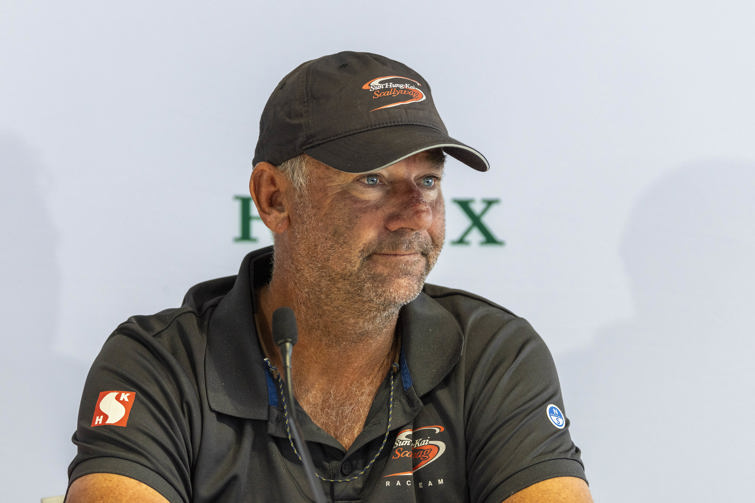
Witt at the Line Honours press conference on 24 December - ROLEX/Andrea Francolini pic.
The Cruising Yacht Club of Australia’s Rolex Sydney Hobart once again reminded sailors why the race remains both revered and ruthless — not because it is always the toughest, but because it is relentlessly precise. Miss the window, and the race moves on without you.
“Commanche just went faster,” was Witt’s rueful assessment. “Too fast.”
The comment was half-joke, half-truth — a nod to the fine margins that define offshore racing.
“That’s why it’s so popular,” Witt added of the 80th running of the race. “Not because it’s always the hardest — but because it’s this.”
Witt looked like he’d been at sea for six months, not a few days.
Giving a withering look to the media scrum, Witt said, “I reckon I’m done.” “That’s it for me,” he said after his 27th Sydney Hobart race.
On the 88 foot, Lucky, the mood could not have been more different after crossing the finish line in fourth place, 24 minutes after SHK Scallywag finished.
Lucky’s American owner, Bryon Ehrhart and his pro international crew led by Kiwi Brad Butterworth, were buoyed after a race that saw them catch up and land in a four-way tussle for line honours with three of the four 100 footers.

Lucky on the toes of SHK Scallywag 100 - ROLEX/Andrea Francolini pic.
“It was a great boat race and scary once in a while,” a fit looking Ehrhart said. “But the boat and crew were well prepared.”
“A long beat into the breeze in 20-35 knots. It was tough on the boat and the crew. Everyone on board did their part in the race. We had some minor breakages only and the crew, as you can see, are all fine,” Ehrhart said.
“We caught up this morning when the breeze lightened off and that gave us more exhilaration. This morning early it was quite light. We saw 3 knots at one point and it gradually built to over 20 knots. We thought and hoped it would stay lighter…
“The last 150 miles wasn’t what we thought would happen. It felt like two separate races,” said Ehrhart. “To finish in daylight was fantastic.”
The Rolex Sydney Hobart has been a long held ambition for Lucky’s owner and the 80th edition was the perfect opportunity. “I’ve been meaning to do this race for 30 years, but couldn’t get here until now,” he said.
Ehrhart said he would consider coming back to do the race again, “But with a different boat. I don’t want to do it with the same boat,” he ended.
Mark Richards’ team on Palm Beach XI finished fifth over the line just after 8.52pm this evening.
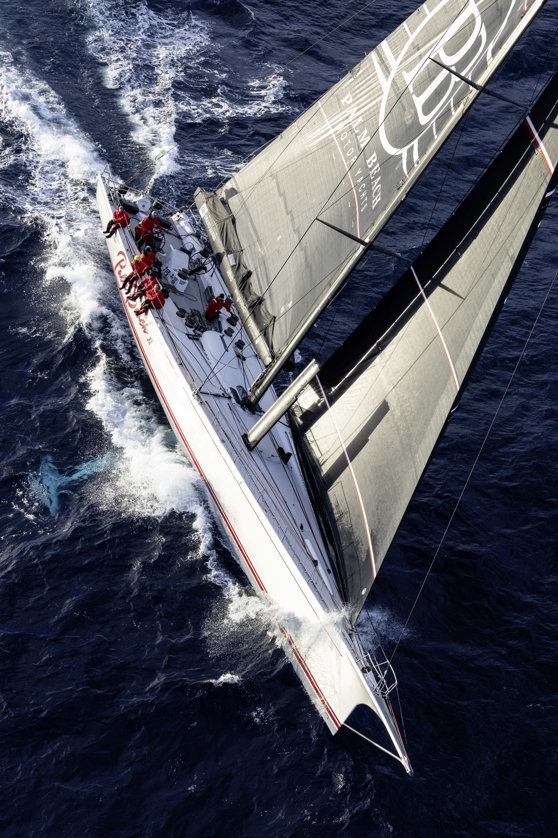
Palm Beach XI on day one - ROLEX/Andrea Francolini pic.
The totally revamped former Wild Oats XI started the race running four brand-new boards, still unproven under full race conditions. While the setup showed early promise, a series of minor issues emerged, forcing the crew to treat the outing almost as a live practice sail rather than a full-tilt performance run.
“We had a few issues along the way — we call it our practice sail,” Richards said. “That’s yacht racing. Things happen.”
The biggest setback came when the boat became entangled in discarded fishing gear, drifting offshore on the first day of the race. It was an old, obsolete fishing net — complete with six heavy steel traps still attached.
“We were forced to stop and heave to for around 40 minutes while they worked to cut the debris free,” Richards said.
“It was really bad,” he added. “It did a lot of damage to the board and the keel fairing. But that’s life.”
Despite the damage, the decision was made to continue racing.
“We decided to keep going and give the boat a proper workout,” said Richards whose boat and crew had little time on the water before the race.
“Once that happened, we were off the pace compared to the others, but we did what we could.”
The incident also highlighted a broader environmental concern, with the crew openly critical of marine debris left behind at sea. And they weren’t the only ones in the fleet to suffer, two others forced to withdraw because of fishing line and fishing nets.
“It’s a shame — that stuff just shouldn’t be in the ocean,” Richards said.
While the damage and delays meant the boat never fully recovered its speed, there were positives to take from the experience. The yacht had only been sailed twice in the past three years, making the race a significant test under pressure.
“The great thing was the boat held together beautifully in some really rough, boat-breaking conditions,” Richards said. “We didn’t break a thing, and we’re pretty happy about that.
“It was a tough race, but we made it through and got here,” he said. “It’s a good stepping stone for next year. We’ll get it back on the pace.”
Steve Dettre and Di Pearson/RSHYR media
/media/3450489/hh_rshyr_performance_ads_970x300px3.jpg)