/media/3450387/white-spirit-r500.png)
White Spirit
VIC
- Sail number
- R500
- Type
- Beneteau First 50
- Owner
- Cyrus Allen

/media/3451504/rshyr-website-news-headers-12.png)
Master Lock Comanche has claimed a hard-fought and emotionally charged victory in the 80th edition of the Rolex Sydney Hobart Yacht Race, prevailing after a race that swung wildly from dominance to dead calm, and from violent seas to a final-day showdown that felt more like a race within a race at the finish.
For co-charterer Matt Allen, the triumph was defined not by outright speed, but by composure under pressure.
Allen has never taken line honours in the Cruising Yacht Club of Australia’s race before. He won three Hobarts overall with his TP52, Ichi Ban in 2017, 2019, 2021. He also won overall as crew on Challenge II in 1983.
Mayo was a crew on Sovereign when she took the double line and overall victory in 1987, when he was 22.
“It’s absolutely amazing,” Allen said after stepping ashore in Hobart, having beaten LawConnect by 47 minutes and four seconds.
“We had a great lead during the race, and then it evaporated this morning. We effectively had to restart. I’ve never seen anything like it in the Sydney Hobart — all the boats so close together on day two. To win it twice makes it even more special.”
Master Lock Comanche (holder of the race record of 1 day 9hrs 15mins 24secs set in 2017 when known as LDV Comanche for Jim Cooney/Samantha Grant) had controlled much of the race. She stretched to a lead of around seven and a half nautical miles — not enormous by maxi standards, but enough to suggest authority. Then, without warning, the breeze shut down. The fleet concertinaed.
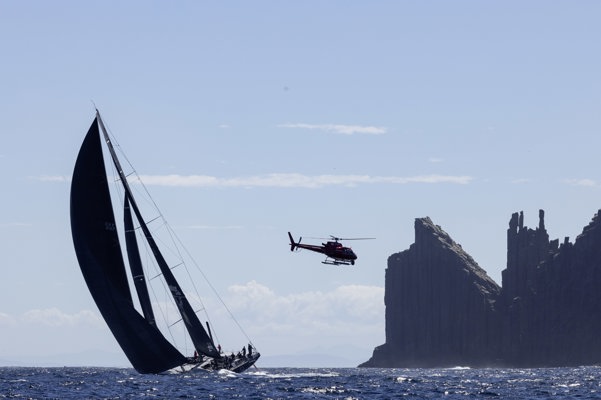
Master Lock Comanche sailing around The Organ Pipes Credit: Rolex | Andrea Francolini
Rivals LawConnect, SHK Scallywag 100 and Lucky (an 88 footer) poured back into contention, turning what had been a strategic offshore contest into a tense three-boat knife fight down the Tasmanian coast.
Master Lock Comanche co-skipper, James Mayo, said the sudden compression tested nerves, but not belief.
“We’re an incredible team, and that’s what we focus on,” Mayo said. “We were there to do a job and show who we are as Master Lock Comanche. When the challenge was thrown at us, we knew exactly what we had to do.”
Allen admitted the moment was deeply uncomfortable.
“It’s not good,” he said. “You’ve had a handy lead, and then you’re watching it disappear. We had to work hard to get it back in the later quarter of the race.”
The key decision came close to shore. While the fleet drifted in glassy conditions, Master Lock Comanche’s crew scanned the coastline for signs of pressure. The call was made to defend inshore — a move that would define the race.
“We stuck to our game plan,” Mayo said. “We wanted to be closer to the coast. We could see something developing there. The breeze filled in from inshore, we got moving first, got the lead back, and then we were able to extend.”
Mayo described the moment the race sprang back to life.
“There was just no wind — it totally dissipated,” he said. “The boats behind caught us, brought the breeze back down, and then we all parked up for a while. But everyone stayed calm.
“We saw puffs developing near the shore, started moving, and suddenly we had a proper boat race. We were only a length apart for close to 100 miles. That was special.”
If the final stages were about precision, the earlier part of the race was about survival. The crossing of Bass Strait delivered some of the most punishing conditions of recent years, with violent seas and relentless motion.
Mayo likened it to “putting scissors in a jar and shaking it,” as the 100-foot yacht slammed off waves and shuddered through the night. Allen said the greatest danger was not equipment failure, but injury.
“Making sure you didn’t get thrown around was the hardest part,” Allen said of the wide boat with little to hold onto below. “That’s how things break — gear and people.”
Master Lock Comanche was not immune. Just minutes after the start, the boat was a bowman down due to injury, effectively racing short-handed from the first turning mark. Another crew member was hurt in a fall below decks as the boat pitched violently.
“At one point, people were going down like flies,” Mayo said. “But the crew just kept stepping up.”
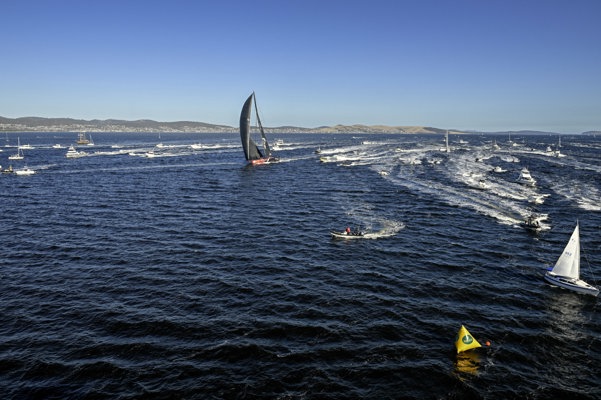
Master Lock Comanche crossing the line in Hobart : Rolex | Kurt Arrigo
While rivals openly reported damage and struggles, Comanche’s approach was to shut out the noise. The boat tracked competitors closely, sometimes separated by just a few hundred metres, but never engaged in distractions.
“We had them all on the tracker,” Allen said. “We knew exactly where they were, how fast they were going, what angles they were sailing. There wasn’t a moment we weren’t watching LawConnect, Scallywag and Lucky.”
Mayo said the turning point came when a small error by one rival opened the door.
“They made a mistake, we crossed them by about a boat length, and from then on our job was to stop looking backwards and start looking forwards,” he said.
The final reward came on the River Derwent, where light winds and smooth water delivered a rare moment of joy after days of tension.
“The run up the Derwent was the best I’ve had in 33 races,” Allen said. “The sailing was superb, and the welcome in Hobart was unbelievable.”
Thousands lined the waterfront as Master Lock Comanche eased into Constitution Dock, greeted by cheers, applause and a sense of shared relief.
“Tasmania embraced us,” Mayo said. “That’s something I’ll never forget.”
For both men, the victory also carried the weight of redemption. Last year’s campaign had ended in frustration, leaving unfinished business.
“We only decided to come back if we were both all-in,” Allen said. “We decided to do it properly.”
Mayo agreed. “Last year was brutal. This was about redemption. You can’t achieve something like this without an incredible team, and that’s what we have.”
As celebrations began — famous Tassie scallop pies promised before drinks — talk of the future was cautious but optimistic.
“You never say never,” Mayo said. “This is a very special boat. She’s like a racehorse — if you look after her, she’ll get you there.”
In a race defined by chaos, closeness and courage, Master Lock Comanche proved that preparation, trust and teamwork still matter most when the pressure is at its peak.
Steve Dettre/RSHYR media
/media/3450489/hh_rshyr_performance_ads_970x300px3.jpg)