/media/3449521/syho_2412cb_29027914.jpg)
MWF Kayle
NSW
- Sail number
- 7878
- Type
- Lyons 54
- Owner
- Making Waves Foundation

/media/3451794/rshyr-website-news-headers-19.png)
Matthew Fifield didn’t come back to the Rolex Sydney Hobart Yacht Race just to survive it - this time, aboard Pacific Road Xanthus - he came to race.
“I’ve done the race three times — the last was last year on Xanthus,” said Fifield, a Boston native who has called Sydney home for the past 12 years.
Last year was about endurance. “We had hard downwind conditions, sailed beyond the boat’s limits — but it held up,” he said of Cruising Yacht Club of Australia’s 628 nautical mile race.
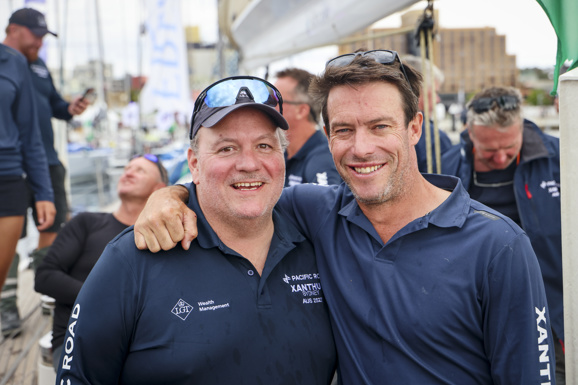
Fifield and White after a busy racing season - Credit: CYCA | Salty Dingo
This year, the mindset changed. With veteran Sydney sailor Mitch White on board, the brief was clear. “Mitch said, ‘Let’s compete this time and do well’,” Fifield said — and Pacific Road Xanthus was ready for exactly that. Xanthus — an X-55 production design weighing 18.5 tonnes — was well suited to what lay ahead. “The boat loves hard upwind conditions,” Fifield said. “It’s forgiving and strong. I ‘m confident in it.”
Confidence, he says, comes from balance — between seamanship, people management and meteorology.
“The whole thing about ocean racing and the Hobart is part taking care of the boat and the second is looking after the crew,” he said. “Then it’s ‘do we have the right weather pattern conducive to the boat’?”
Preparation mattered. Xanthus contested the Bird Island and Tollgate Island races as lead-ups, with the latter proving particularly valuable.
“The Tollgate was especially important — we had 35 knots, it was a hard race,” Fifield said.
Those shorter offshore events came with their own challenges. “Everyone’s on deck and roles can get confusing, unlike the longer Hobart where you have proper watch systems and people in place for each.”
The crew mix reflected the ethos of the campaign: experience alongside opportunity.
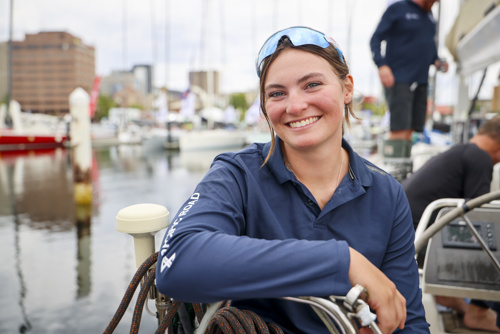
Ali Braden with a big smile on her face after her first RSHYR - Credit: CYCA | Salty Dingo
Seasoned sailors such as Mitch White, Tommy Spithill and Peter Winter sailed alongside first-timers, including Fifield’s son James, father-and-son pair Justin and Oscar Brownbill, and Ali Braden, the youngest female in the race at just 18.
“It was special competing this year,” Fifield said. “It was a bit of an everyman team — world-class sailors, everyday sailors and first-timers. In this race, everyone had to rally around.”
The 80th race itself delivered contrasts that only the Hobart seems capable of producing.
“The funny thing about this race is it started off difficult, but it was Xanthus conditions,” he said.
Moments of wonder followed moments of brutality. “We had the dolphin show — around 40 of them stayed with us. Then we rounded Tasman Island and got punched in the face with 40-knot winds, two or three times.”
For Fifield, some of the most enduring memories came in the quiet hours. “Steering under the stars at night was so special,” he said.
When the pressure was on, the crew responded. “We tried to keep the levels of participation up,” Fifield said. “Everyone had to rally around during the dramatic moments — and they did. That epitomised the race.”
It is that mix of hardship, teamwork and fleeting beauty that keeps sailors coming back.
"Of course I’ll do another Hobart,” Fifield said. “How could you not?”
His philosophy is simple. “I wanted a second-hand boat off the shelf — it’s a production boat — and to sail the hell out of it,” he said.
Growing up sailing wooden boats with his dad in Marblehead, Massachusetts, heavy weather was rare. In Australia, it is expected — and embraced.
For Fifield and Pacific Road Xanthus, this Hobart was not just about finishing, but about competing, committing, and discovering again why the race endures.
Di Pearson & Steve Dettre/RSHYR media
/media/3450489/hh_rshyr_performance_ads_970x300px3.jpg)