/media/3445995/noakessydgc2023_0026.jpg)
Pacman (DH)
QLD
- Sail number
- 110
- Type
- Young 11
- Owner
- Peter Elkington

/media/3451068/clare.png)
While the Rolex Sydney Hobart Yacht Race is often defined by its 100-foot maxis charging south, crews on smaller boats know the race is rarely decided by raw speed alone.
Navigator Clare Costanzo, racing on one of the smallest boats in the fleet, the GP42 footer Ambition, says conditions play a decisive role in determining whether size becomes an advantage or a liability.
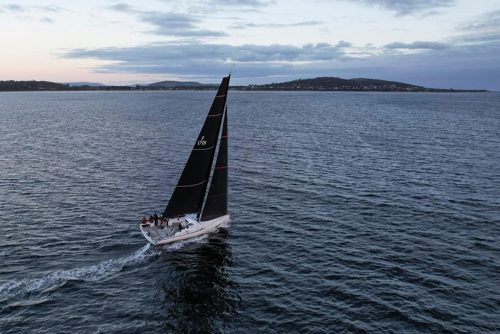
Ambition racing in Tasmania. Image: Fiondry Photography
“It really depends on the forecast,” Costanzo said. “If it’s an upwind race, waterline length matters — the longer boats are just going to be faster. But if there’s downwind sailing, or marginal planing conditions, we can hold our own quite well.”
In stronger or more variable conditions, smaller boats can remain competitive against yachts 10 or 20 feet longer, particularly under handicap. Costanzo said Ambition can stay with larger 50-footers when the breeze is up or when conditions are on the edge of planing.
Strategy for smaller boats in the Cruising Yacht Club of Australia’s race is therefore less about beating the entire fleet and more about winning a series of incremental battles.
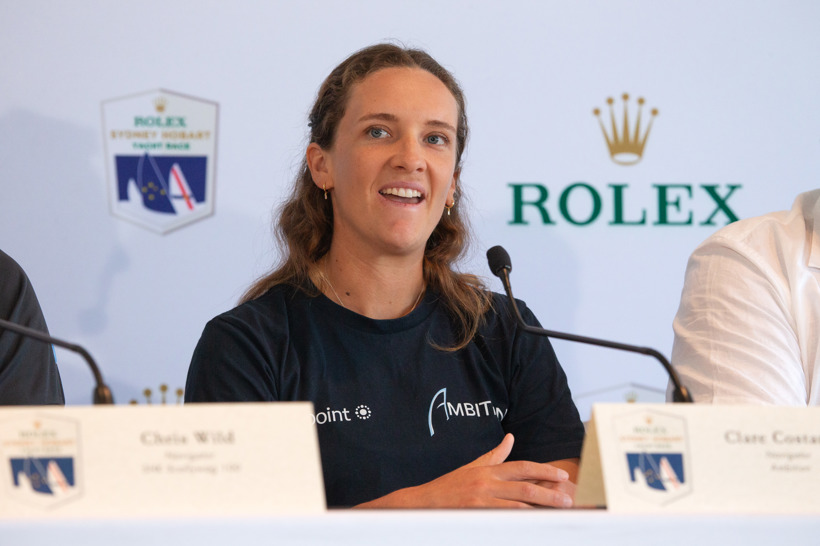
Costanzo speaking at the Long Range Weather Press Conference at the CYCA. Image: CYCA/Ashley Dart
“Everyone wants to win overall,” she said. “But to do that, you have to beat the boats directly around you first.”
For Costanzo’s team, in this year’s 80th Sydney Hobart, that means targeting a near-identical rival that rates slightly higher under the handicap system.
“That’s your starting point. Beat them, then see what else opens up.”
The race’s most chaotic moments often come before it truly begins. Boxing Day’s Sydney Harbour start can resemble what Costanzo describes as a “washing machine”, with boats of vastly different sizes converging at speed.
“You can’t win the race in the Harbour,” she said, “but you can definitely lose it.”
Early penalties, collisions or damage can end a campaign before the fleet even reaches open water. Costanzo said the priority for smaller boats is a clean, controlled exit rather than aggressive positioning.
“Getting out safely, cleanly, and without breaking anything — that’s huge.”
Decision-making in the Harbour is led by the tactician and skipper, who call crossings, ducks and positioning relative to other boats. Costanzo plays a supporting role, particularly around the start line, helping ensure the boat avoids being over the line early.
Once offshore, communication becomes critical — especially on smaller boats where roles overlap and margins are tight.
“Good communication doesn’t just happen on Boxing Day,” Costanzo said. “It’s built well before the race.”
She said successful crews reduce noise by establishing clear communication styles and responsibilities in advance.
“Keeping fewer people talking is often better. Everyone needs to know the plan.”
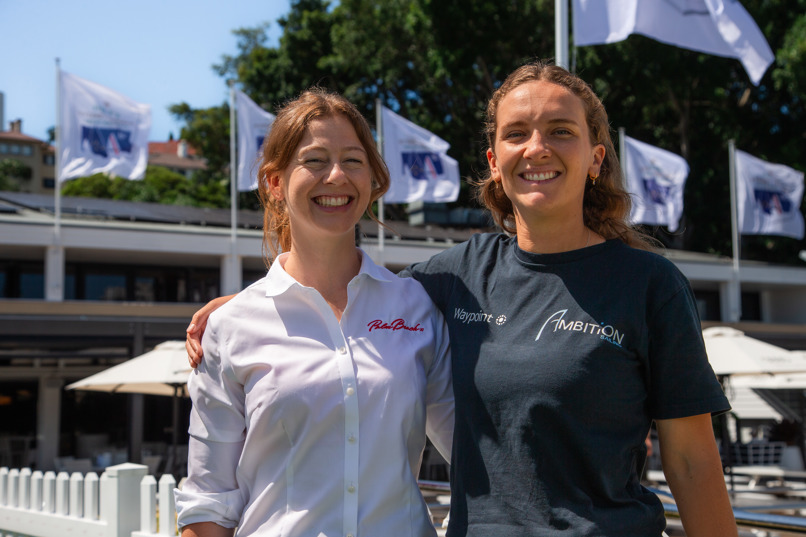
Alice Tarnawski (Palm Beach XI) and Clare Costanzo. Image: CYCA/Ashley Dart
Costanzo’s path into offshore sailing began at a grassroots level, sailing Hobies with her family, before progressing through dinghies, skiffs and eventually offshore yachts. She has since raced on boats up to 62 feet, including on the Fastnet Race in Europe.
Now balancing part-time work with an expanding sailing career, she hopes to continue moving up through the fleet.
“You take it in small steps,” she said. “One goal would be to navigate alongside more experienced navigators — learning from people who’ve done this at the highest level.”
For smaller boats, the Rolex Sydney Hobart is rarely about headline speed. Instead, it is a test of discipline, decision-making and consistency — a race of small victories that, under the right conditions, can add up to something much bigger.
Steve Dettre/RSHYR media
/media/3450489/hh_rshyr_performance_ads_970x300px3.jpg)