/media/3449133/syho_2412af_0485.jpg)
Celestial V70
NSW
- Sail number
- ITA70
- Type
- Volvo Open 70
- Owner
- Sam Haynes

/media/3451035/lindsay.png)
During a post-Fastnet Race celebratory lunch for the Kialoa II crew in Cherbourg, France, in August, co-owner Paddy Broughton raised a glass to the navigator, offshore sailing legend Lindsay May OAM.
Kialoa II was the 88th monohull (from a fleet of 404) over the finish line and placed 10th in IRC 1A and 19th in IRC 1. Significantly, it was the 100th anniversary of the 695 nautical mile race, and May’s last offshore race. Emotions ran high as the Kialoa II crew honoured a man whose extraordinary offshore sailing career has spanned more than half a century.
May began his sailing career in 1973 aged 23. His first Sydney Hobart that year was on board Peter Rysdyk’s Onya of Gosford.
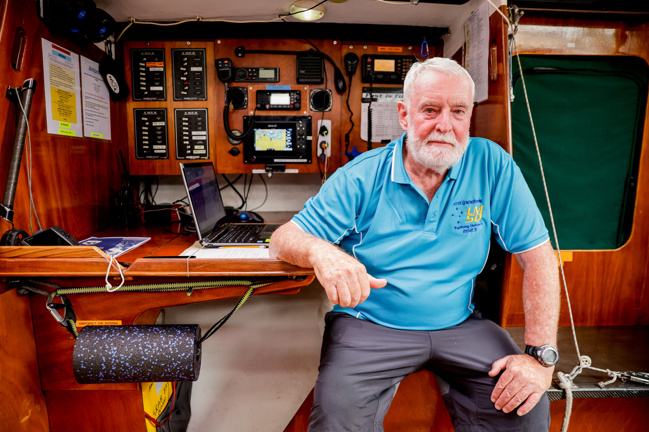
Lindsay May in the navigator's seat. Image: CYCA/Salty Dingo
That race was just the start for May, it sparked a remarkable 50-year run (excluding 2020 when the race was cancelled) — a feat other aspiring Sydney Hobart tragics can only dream about.
May has experienced every high and low of the iconic race over the years. He has won the race once on Line Honours and has experienced three Overall wins. He famously played a key role in the 1993 rescue of man overboard John Quinn.
May’s 50th and final Rolex Sydney Hobart was in 2023 on board Geoffrey Hill’s Antipodes.
Sun damage and the realities of ageing gracefully prompted May’s retirement from offshore racing.
CYCA Media caught up with May who shared his more memorable Sydney Hobart achievements and advice for those preparing to take on the 628-nautical-mile challenge on Boxing Day.
My eight years sailing on Kialoa II has certainly been a highlight. Paddy and Keith Broughton [the owners of Kialoa II] and Mel [Paddy’s wife] run a very well-organised program and attract a group of like-minded, talented people. We enjoy our company both on and off the water, a dynamic mix of young and old crew.
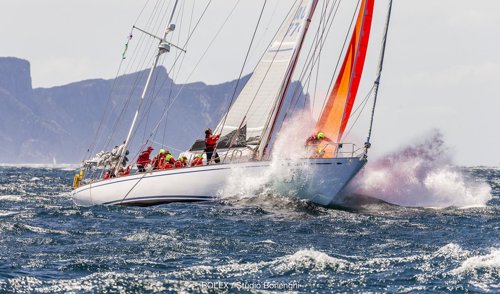
The magnificent Kialoa II. Image: ROLEX/Carlo Borlenghi
The first response you receive when referring to the Rolex Fastnet Race is, “Isn’t that the race where all those people died?” Yes, sadly it is, but that occurred 46 years ago [in 1979, 21 people died]. It is amazing how these tragedies never fade. Much was learned from that race, and especially by the CYCA.
So, just like the Rolex Sydney Hobart, bad weather and safety are always on our minds. The Fastnet differs in that tides have a big impact, whereas for Hobart you’re trying to maximise the benefit of the East Australian Current.
The Fastnet has you in close proximity to the beautiful South-East coast of England and then a 160 nautical mile leg out to the iconic Fastnet Rock. Just to see that lighthouse is a moment to remember.
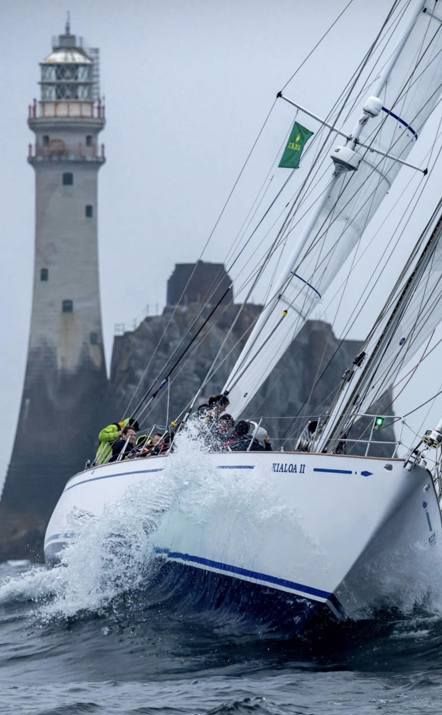
Kialoa II competing in the 2025 Rolex Fastnet Race. Image: ROLEX/Kurt Arrigo
The 360 nautical mile leg home usually results in fast downwind sailing and then the final 100 miles is significantly impacted by tide, which can be favourable or make for slow going. It’s a little bit like the last 50 miles in the Hobart race from Tasman Island to the finish. This can be a nice run in a sea breeze or a frustrating long night and morning with no breeze.
You need to turn up and pitch in. In the early days, the crew did most of the maintenance and the work required to go to sea. Paid professionals do the boat work on programs today, meanwhile the professional crew arrive, race and depart.
The sport has lost a lot of the camaraderie that brings together a Kialoa II type of crew.
As far as the Hobart race is concerned, you need to be race-fit on Boxing Day. This was not my case in 2024. Surgery and a skin graft meant I was unable to compete.
The most important topics covered are to look after your gear, keep the boat tidy, look after your crew and to look after yourself.
The biggest detriment to an ocean racing yacht is seasickness. It can be managed. But if it can’t, it should never have occurred in the first place. This is why lead-up races are so important.
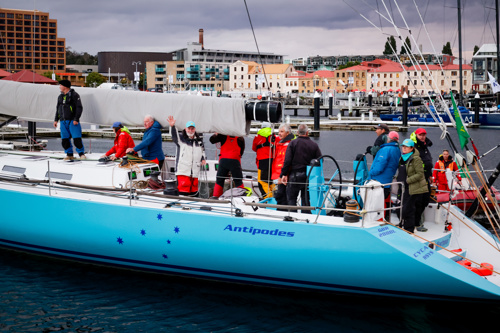
Lindsay May arrives in Hobart in 2023 on board Antipodes. Image: CYCA/Salty Dingo
I have been incredibly fortunate to sail on some wonderful yachts with fantastic crew but none of this would have happened without generous owners. I’m grateful to the likes of Peter Kurts [Once More Dear Friends, Madeline’s Daughter and Love & War], George Snow [the Farr 65 and Jutson 80 both named Brindabella], Jim Cooney [Brindabella], Geoffrey Hill [Swan Song, Strewth and Antipodes] and Paddy Broughton.
People ask me, ‘Do I own a yacht?’ And my response is, “No, I can’t afford the yachts I sail on.”
Across 50 years, I’ve sailed on 20 yachts and with 18 owners. Without these people who fund and make these opportunities available, we would not have this magnificent sport.
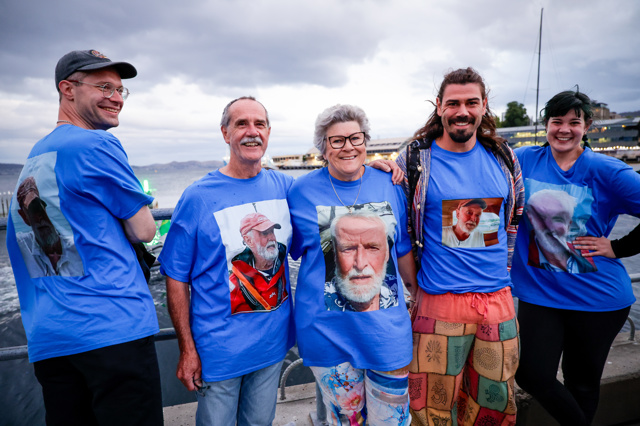
May's 2023 Sydney Hobart welcome party. Image: CYCA/Salty Dingo
There are so many outstanding sailors and characters that I will get myself into trouble by omission, only to say thank you to all of them for their friendship and acceptance. When we end up in the same location, we all love to meet up and reminisce. When we get together, we say, “Crikey we were good!”
My best Sydney Hobart race was one of the 10 races that I failed to finish.
In 1993 on the Irish yacht Atara we pulled off a Hobart miracle [just 38 of 104 starters made it to Hobart that year]. John Quinn (Mem) had been overboard for five hours, at night. [The stitching on his safety harness came apart when the boat was hit by a huge wave].
We had lost our mast [on Atara] and navigated back some 22 nautical miles to where I figured John would be. We were assisted by a tanker that spotted him with its searchlight, which was incredible. About 10 minutes later we almost ran him over.
John was in surprisingly good condition when retrieved, although he suggested he probably had “about 30 minutes left”.
Atara had considerable damage to the hull. We asked John: “Whilst you were being dragged along the hull, did you notice the delamination?”
Quick as a flash, he replied: “When the ambulance arrives, you don’t check out the condition of the paintwork.” I’ve dined out on this often.
Ocean racing is a hostile environment – equipment breaks and technology fails. Once you leave the dock you can’t go to the shop. You need to be properly prepared.
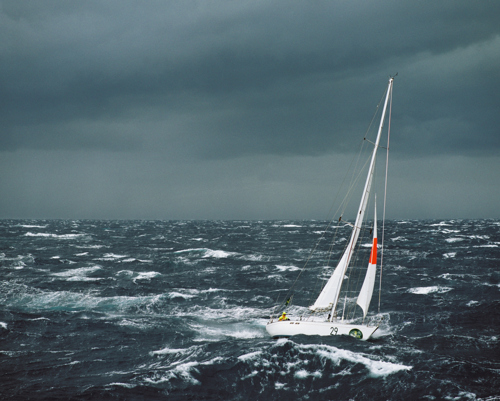
Tough conditions in the Rolex Sydney Hobart. Image: Richard Bennett
I live by checklists but there’s always a last-minute rush, so be well-organised. With a competent crew and a mix of skills, many challenges can be solved.
Among some Love and War crew I have the nickname ‘Kenny’ [Kenny is a mockumentary about a Melbourne plumber called Kenny] after disassembling and repairing the head [the toilet] in 2006. Whilst the head isn’t critical to boat speed, if it’s blocked it can take your mind off the main aim of racing. Mind you it was more rudimentary in the early days.
Paddy Broughton [Kialoa II] is a master at repairs and workarounds. It’s amazing what you can do with an angle grinder, vacuum cleaner and gaffer tape.
My Overall wins were unexpected.
1984 on Indian Pacific [owned by J Eyles and Gunter Heuchmer], ‘the making leg’, Peter Kurts’ golden rule [to sail the closest angle to the mark and that was the best course or leg to make], took us 115 miles off Eden. Seas were horrendous and sky obscured. I was unable to take sights and the satellite navigation was intermittent. Our position put us abeam of maxis on the shore. The race director kept moving our position back 60 miles north. We finished fourth over the line and won on handicap. Yes, good boat and a great crew, but not a favourite.
1991 was different, representing Ireland with Harold Cudmore and Gordon Maguire on board Atara. We sailed a very good race and beat Lou Abrahams’ Ultimate Challenge by one minute 50 seconds.
2006 on Love and War I was convinced, as was Peter Kurts, that the ‘old girl’ could win a third time. There is no reason she couldn’t win a fourth. With an unprecedented four-knot current and magical wind shifts, plus morning breeze in the Derwent, we won by 58 minutes. That win demonstrated to owners across the globe, that old boats still had race winning potential.
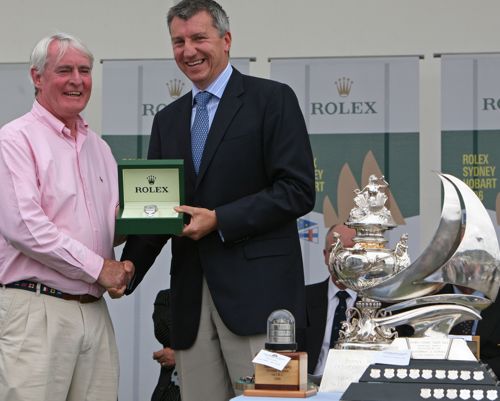
May at the presentation ceremony following Love & War's 2006 Overall win. Image: ROLEX
Line Honours win:
Brindabella was the gunboat on the sailing scene in the mid-90s. We held almost every race record on the East Coast, but the Sydney Hobart was the race the top overseas maxis wanted to win on Line Honours. In the nine years I navigated her south, we had four seconds, two DNFs, until she became outclassed from 2000.
1997 was Brindabella’s best chance against the well sailed but slightly smaller Exile from Hong Kong. Off the north-east Tassie coast, we were sailing alongside Exile at midnight with the crew exchanging ‘commentary’.
We entered the Derwent ahead of Exile and made for the western shore while she went up the traditional eastern shore and hooked into some sea breeze. It looked like the bridesmaid dress would come out again but Exile fell into a hole. Both subsequently raced to the finish in a building sea breeze and Brindabella managed to finally take Line Honours by mere minutes.
In the mid-70s I completed a celestial navigation course run by Gordon Marshall at the CYCA.
Without a boat for the 1975 race, I contacted Gordon suggesting I could sail as navigator. A week later he came back with two invitations and some fatherly advice, “If I were you, I’d take the first offer you get.” That I did. And so, I joined Cliff McGarry on board Middle Harbour Yacht Club’s Dancing Mouse.
1975 was fast. In the area off Maria Island, Tasmania, I managed to get one sun sight that indicated we were probably 40 nautical miles south of the DR [dead reckoning] position. This sight cross-referenced with radio direction fixes from Hobart confirmed our location and the decision was made to gybe. The first piece of Tasmania we saw was Cape Raoul. Many yachts overstood and some even beat back 40 nautical miles to Storm Bay.
My first race as navigator had a very pleasing outcome and decades of fabulous invitations followed.
In the early days pre-GPS, a competent navigator was highly sought after. Even into the days of GPS, experience and expertise were recognised, but today just about anybody with an iPhone can analyse the weather, data and run course optimisation and do an extremely good job. It’s when everything turns to custard that a compass, paper chart and pencil come into their own.
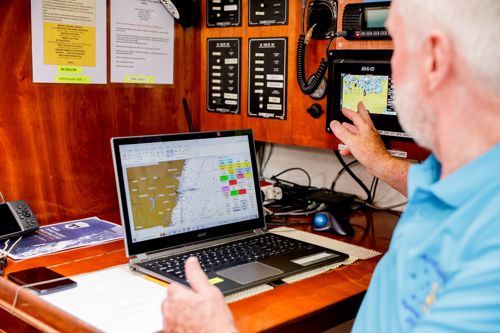
May in his element. Image: CYCA/Salty Dingo
Unfortunately, I am slowing down from offshore racing due to skin cancer operations that prevented me competing in the 2024 Rolex Sydney Hobart and at 76 years of age it’s challenging to contribute to the race.
In the past when asked whether I was racing to Hobart, my response has always been, “What else do you do on Boxing Day?”
Missing the 2024 race was tough, but there was no way I could do the lead up races. So sadly, I had to step off the wonderful Love and War program.
On Boxing Day 2025, you will find me somewhere on the water watching the race start.
My son Andrew owns Nirvana a 72-footer that competed in two Hobart’s in the 1950s. She’s been getting a refit in the shed for the last few months, and we plan to compete in the Sydney Hobart Classic Yacht Regatta in December. We will spend some time on the harbour and short coastal cruising. Although she’s sailed extensively on either side of the Pacific, I don’t think Andrew has intentions to go well offshore.
Ocean racing brings out the best in people. In so many ways your life depends on others – strong bonds are developed that extend way beyond the finish line.
I wish all competitors safe sailing and a successful arrival in Hobart and that they celebrate in true Sydney Hobart style.
As Peter Kurts said, “If you have something to celebrate, throw a party”. And that’s what we did in Hobart 2023 to celebrate my 50-consecutive Sydney Hobarts, along with so many who were part of the story.
Greta Quealy, RSHYR media
/media/3450489/hh_rshyr_performance_ads_970x300px3.jpg)