/media/3450579/acsbwps-tollgate-islands-race-cyca-ashley-dart-29.jpg)
KD1
NSW
- Sail number
- 5588
- Type
- Farr 40
- Owner
- Joe de Kock

/media/3451432/pre-start-pics.png)
A strengthening southerly wind and a notable upgrade in wave height are the key changes competitors face ahead of the start of the 2025 Rolex Sydney Hobart Yacht Race, with forecasters warning of a rougher opening phase than earlier briefings suggested.
Speaking at the final Compulsory Race Briefing, that includes a weather update at Cruising Yacht Club of Australia (CYCA) headquarters, the Bureau of Meteorology’s (BOM) meteorologist, Edward Townsend-Medlock, said the overall pattern remained familiar, but conditions at the sharp end had hardened since previous forecasts — particularly along the New South Wales south coast.
The most significant change is in the sea state. Southerly swells have been revised upward to 3-4 metres, compared with 2-3 metres forecast earlier in the week. Those larger swells, combined with strong southbound coastal currents, are expected to create confused and uncomfortable seas, especially between Jervis Bay and Montague Island.
“We’ve upgraded the swell coming from the south,” Townsend-Medlock told crews ahead of the 80th Sydney Hobart, which starts at 1pm today. “That’s probably the biggest change since the last briefing and it’s something to watch carefully on the south coast.”
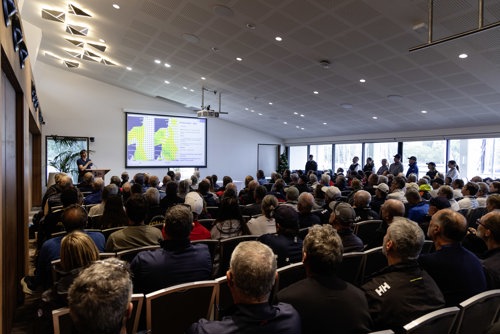
The final Compulsory Race Briefing - ROLEX/Andrea Francolini pic.
At the start, yachts can expect southerly winds of 20–25 knots once clear of Sydney Heads, slightly stronger and more persistent than an earlier forecast indicated. Inside Sydney Harbour, winds are forecast to be a lighter 15–20 knot southerly, with boats exiting near high tide before the Harbour begins to drain early in the afternoon.
While the opening conditions are expected to be demanding, the forecast still points to a gradual easing later in the race — though not without complications.
“This’ll be the race that keeps on giving – starting from when we leave the Heads, going into Bass Strait, going down the Tasmanian Coast – and then there’s the Derwent and the finish – and who knows who will be there first,” said Iain Murray, Master Lock Comanche tactician and a veteran of 30 Sydney Hobarts.
Southerly winds are now expected to hold through both Friday and Saturday, longer than some competitors may have hoped. Although winds should begin to ease from the north first, the south coast is forecast to retain stronger pressure for much of Saturday, with large residual seas continuing even as wind strength tapers.
Townsend-Medlock warned crews to prepare for a cold and wet first night, with showers possible and temperatures dropping quickly once sails and decks are soaked. “With strong southerlies and spray, it’s going to feel particularly cold overnight,” he said.
The outlook improves markedly on Sunday, when yachts moving into Bass Strait are likely to encounter light winds of 5-10 knots, or even variable conditions, as the fleet passes under the centre of a high-pressure system. That lighter air is consistent with earlier forecasts, but the transition may now be more pronounced due to the stronger southerly preceding it.
Despite the drop in wind, seas are expected to remain unsettled. Long-period southerly swells will continue to roll through, and boats nearing Tasmania could also encounter a competing westerly swell, creating a choppy surface despite relatively calm wind conditions.
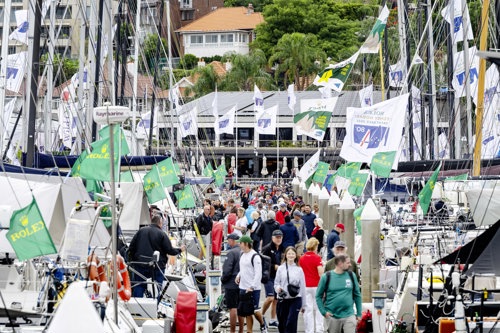
Busy dock - ROLEX/Andrea Francolini pic.
Looking further ahead, forecast confidence decreases. Townsend-Medlock highlighted a growing divergence between European and US weather models around New Year’s Eve, with implications for boats still on the course — or planning their return sail north.
The European model suggests a slower-moving system, delaying the arrival of stronger winds by about a day. In contrast, the US model brings a developing low pressure system through earlier, with the potential for gale-force northerlies followed by a strong southerly change, affecting eastern Tasmania, Bass Strait and possibly the New South Wales coast.
“That difference in timing is important,” Townsend-Medlock said. “The European solution remains our preferred scenario, but the US model is more aggressive and can’t be ignored.”
Race organisers echoed the need for caution. CYCA Commodore and competitor Dr Sam Haynes said the fleet should remain alert to updates as conditions evolve, particularly beyond the first two days.
“What we’re really focused on is getting everyone through the opening 30 hours safely,” Haynes said. “That’s where the biggest change in the forecast has been, and where boats are likely to be tested the most.”
Ocean currents remain largely unchanged from earlier briefings, with the strongest southbound flow — up to 2 knots — expected between Jervis Bay and Montague Island. That current, running against the upgraded southerly swell, may further complicate conditions in the early stages.
For Hobart itself, little has changed. The forecast remains cool and cloudy with occasional showers, but no severe conditions expected at the finish at this stage.
In summary, while the broad weather pattern is familiar, competitors now face a tougher start, bigger seas, and a longer-lasting southerly than previously forecast — followed by a lighter, more tactical phase as the race progresses south. As ever, in offshore racing, the margin between challenge and opportunity will depend on timing, preparation, and how crews adapt to the evolving conditions.
Steve Dettre/RSHYR media
/media/3450489/hh_rshyr_performance_ads_970x300px3.jpg)